Sagene and the falls of the Akerselva
A walk in Oslo · 11 stops · 3.7 km, about 50 min on foot
The falls on the Akerselva first drove sawmills and grain mills, then factories, and in the 1880s the works at Vøyenfallene were the largest factory in Norway. Byantikvaren has recorded the buildings one by one, the weaving mills and the workers' housing around them, and the walk goes up the river from Sagveien to Bjølsen.
-
1. Sagveien 8 -Brænna
Workers' housing, 1848
Nils Olaus Young pulled down a single-storey log house and put this up in its place, three years after he had started Vøiens Bomuldsspinderi further up the street. Workers' housing was not charity alone. It tied the workforce to the company and made it easier to bring in people from outside the town, and the register itself notes that it was also a way of keeping social control. Arbeidermuseet today has a flat on the ground floor furnished as it was in the early 1900s.
Ved folketellingen i 1865 bodde det 59 mennesker i Sagveien 8, fordelt på 13 husstander, altså flere husstander enn leiligheter.
Kulturminnesøk, Riksantikvaren, NLOD 1.0

Then: Hans Emil Erichsen - Øvre Foss teglverk. - Oslo Museum - OB.U094, circa 1865 · Hans Emil Erichsen / Oslo Museum · CC0 · Wikimedia Commons Source: Kulturminnesøk, Riksantikvaren
-
2. Hønse-Lovisas hus - Sandakerveien 2
Sawmaster's house
A small weatherboarded log house on the slope down to Vøyenfallene, probably built as a home for a sawmaster early in the 1800s. The name is not the house's own. Oskar Braaten grew up in Holsts gate next door, and the character Hønse-Lovisa in his play “Ungen” from 1911 looks after the factory girls who have had children out of wedlock. Braaten is said to have told people that this was the house he had in mind. His bust stands by Beierbrua directly opposite.
Eldstedatteren Amalie Birgitte (f. 1857) er oppført som ”arbejderske” ved spinneriet, som lå rett nedenfor, ved elven.
Kulturminnesøk, Riksantikvaren, NLOD 1.0

Then: Hjula Væverier, Akerselva, Hønse-Lovisas hus, Den Norske Hesteskosømfabrik, 1890–1900 · J. David · Public domain · Wikimedia Commons Source: Kulturminnesøk, Riksantikvaren
-
3. Sagene skole - Sagene bad - Biermanns gate 2
School and baths
Sagene skole was founded in 1741 as the first permanent school for the common people in Aker, and together with Møllergata it is the oldest in the city. Around 1882 it had 1710 pupils, more than ever before or since. The primary school building went up between 1922 and 1926, and the baths next door were then extended with a pool twelve and a half metres long. Oskar Braaten left school here in 1896. During the war the school was requisitioned and used as barracks.
I 1926 ble Sagene skole den første i byen med eget svømmebasseng.
Kulturminnesøk, Riksantikvaren, NLOD 1.0

Then: Sagene bad. Fotograf A. B. Wilse, before 1924 · Anders Beer Wilse · CC BY-SA 4.0 · Wikimedia Commons Source: Kulturminnesøk, Riksantikvaren
-
4. Hjula Væveri - Sagveien/Maridalsveien
Weaving mill
Halvor Schou bought Hjulafossen and founded the weaving mill in 1855. The fall was strong enough to drive four hundred looms with a water turbine from Myrens Mekaniske Verksted, and his brother-in-law Oluf Roll designed the factory on German and British models. In the 1880s the works at Vøyenfallene had more than eight hundred employees. Hjula closed in 1957, and the register counts it as the first of the big textile factories to go under. Large parts of the complex burned in 1971, and much of what you see was rebuilt in 1974.
Sammen med nabobedriften Knud Graah/Nedre Vøiens Bomuldsspinderi, var Hjula kraftsenteret i norsk tekstilindustri.
Kulturminnesøk, Riksantikvaren, NLOD 1.0

Then: Foss Spinderi, Graahs spinneri og Hjula veveri, ca. 1865, Oluf Vilhelm Falck-Ytter, A-10408 Ua 0002 022, circa 1865 · Oluf V Falck Ytter · CC BY-SA 3.0 · Wikimedia Commons Source: Kulturminnesøk, Riksantikvaren
-
5. Maridalsveien 78 - BIERMANNSGÅRDEN
Suburban farm
Three weatherboarded log houses built together at an angle along Maridalsveien, with a history going back to the beginning of the 1700s. The farm is named after Johan Frederik Biermann, who took it over in 1810 and in his will left a fund to run a small burgher school here. It ran from 1855 to 1873 and later became a woodwork school. But there had been a school in the house long before that.
Sagene skole hadde allerede i årene 1796-1806 hatt tilhold i Biermannsgården, som dermed antas å være Oslos eldste skolebygning.
Kulturminnesøk, Riksantikvaren, NLOD 1.0

Anne-Sophie Ofrim · CC BY-SA 3.0 · Wikimedia Commons Source: Kulturminnesøk, Riksantikvaren
-
6. Nedre Papirmølle - Glads Mølle - Sandakerveien 10 A
Paper mill
Built as a paper mill in 1736, of weatherboarded timber on a high masonry ground floor, with a mansard roof and dormers. There was an even older paper mill on the Akerselva at the time, Øvre papirmølle, and in the 1740s both came under the same owners. The name Glads mølle comes from the proprietor Glad, who ran the business in the 1800s. Papermaking stopped in the 1870s and the building was sold to Hjula Veveri. It has been a printing works since 1959.
Glads mølle regnes som Oslos eldste bevarte industribygning.
Kulturminnesøk, Riksantikvaren, NLOD 1.0

Bjoertvedt · CC BY-SA 4.0 · Wikimedia Commons Source: Kulturminnesøk, Riksantikvaren
-
7. Maridalsveien 87 og 87 b - Vøien gård og kornmølle - Hjula Væveri
Farmhouse and corn mill
Here the farmhouse of Nedre Vøyen farm stands together with the industry that grew up around it. The largest building down by the riverbank is from 1983 and was put up on the grey stone walls of Nedre Vøien Kornmølle, which burned in the 1960s. Parallel to it stands a two-storey building that Halvor Schou put up after he took over the mill in 1873. The narrow south wing belonged to the old corn mill and is probably older than 1860.
Industribygningene har høy bevaringsverdi som del av industrimiljøet, det gjelder også bygningen fra 1980-tallet som har en utforming svært godt tilpasset de eldre bygningene, samt gjør bruk av eldre bygningsrester som stammer fra den opprinnelige kornmøllen.
Kulturminnesøk, Riksantikvaren, NLOD 1.0

Ryan Hodnett · CC BY-SA 4.0 · Wikimedia Commons Source: Kulturminnesøk, Riksantikvaren
-
8. Maridalsveien 89 - Simonstuen - Postmakerløkken
Soap factory
Probably put up as a warehouse for Myrens verksted in the second half of the 1800s, and extended in 1903 and 1908 by the architect Carl Konopka. By then it was a soap factory, Hestbek Christensen Sæbefabrik, and it held on here for many years. The building has been extended so many times that it has several different roof structures over it. The clouds on the façade are not old.
Fasadedekoren som forestiller en himmel med skyer ble laget i 2006 for reklamebyrået Skyskraper, som holder til i huset.
Kulturminnesøk, Riksantikvaren, NLOD 1.0
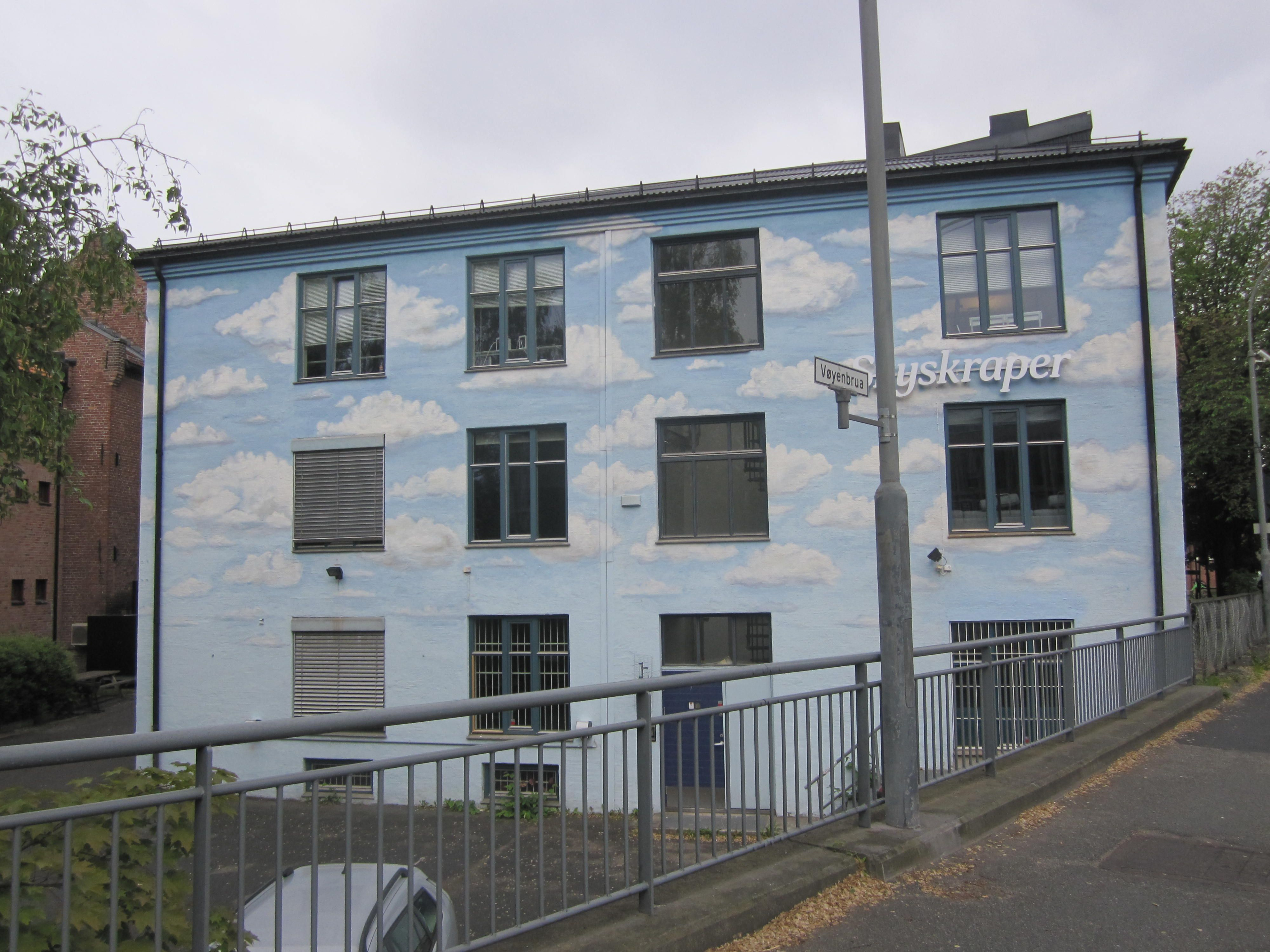
Byantikvaren, 2015 · CC BY · Kulturminnesøk Source: Kulturminnesøk, Riksantikvaren
-
9. Bentsebrua
Iron bridge
An iron bridge in two spans on large granite foundations, completed in 1901. The deck and parts of the railing have been replaced, but the trusses and the masonry stand as they did when it was new. There was a bridge here long before, and the register mentions the bridge at Lilleborg as early as 1829.
Denne konstruksjonen er typisk for flere bruer langs Akerselva.
Kulturminnesøk, Riksantikvaren, NLOD 1.0

Then: Bygging av Bentsebrua og Bentse Teglverk OB.OH469, 1896 · Oscar Hvalbye · CC BY-SA 3.0 · Wikimedia Commons Source: Kulturminnesøk, Riksantikvaren
-
10. Lilleborg fabrikker
Factory complex
Lilleborg Fabriker was founded in 1897 and carried on a business that was already on the property. From 1930 it worked together with De Nordiske Fabriker, shortened to De-No-Fa, and in 1959 both were taken over by Borregaard, which later became part of Orkla. Production at Sandaker ended in 1997, and many of the factory buildings are now flats.

Then: Bryggen, vi drukner i varer - no-nb digifoto 20160304 00167 NB NS NM 08613, 1899 · Narve Skarpmoen · Public domain · Wikimedia Commons Source: Kulturminnesøk, Riksantikvaren
-
11. Bjølsen Valsemølle - Sandakerveien 60-66/Treschows gate 2-8
Roller mill
Grain was ground at Bjølsen as early as the Middle Ages. In the 1870s the mill went over from millstones to rollers, and in 1895 all production moved to the Sandaker side of the river, where the rye mill from 1896 was the largest of its kind in Scandinavia. The Bjølsen side became offices and housing, and a gallery-access house from around 1850, built as workers' housing, still stands there.
Formålet med å bevaring og vern er å ivareta Bjølsen valsemølle som er et av de siste industrianleggene i indre by som fortsatt er i funksjon.
Kulturminnesøk, Riksantikvaren, NLOD 1.0

Then: Bolighus - NB MS G4 0645, between 1880 and 1910 · Marthinius Skøien · Public domain · Wikimedia Commons Source: Kulturminnesøk, Riksantikvaren


More walks
- The medieval town in Gamlebyen (Oslo)
- The cup marks on Ekeberg (Oslo)
- The synagogue that became a mosque (Oslo)
- Kvadraturen, the town that was moved (Oslo)
- Telthusbakken and Gamle Aker (Oslo)
- The brick town and the protected residential district (Oslo)
- Sámi and multicultural Oslo (Oslo)
- Traces of the war in the centre (Oslo)
- From Aros to Latinerkvarteret (Aarhus)
- Medieval Amsterdam (Amsterdam)
- Hendrick de Keyser's Amsterdam (Amsterdam)
- From the royal estate to Bryggen (Bergen)
- Viking and medieval Dublin (Dublin)
- The Georgian north city and the Rising of 1916 (Dublin)
- Constance Markievicz's Dublin (Dublin)
- The Royal Mile, castle to abbey (Edinburgh)
- Sophia Jex-Blake's Edinburgh (Edinburgh)
- From Senate Square to Katajanokka (Helsinki)
- Tove Jansson's Helsinki (Helsinki)
- Med Tang Kristensen til fortællerne (Jylland)
- The medieval town and the two fires (København)
- Christianshavn, the town by the canal (København)
- Hans Jonatan and the Schimmelmanns' Copenhagen (København)
- The City of London from Londinium to the Blitz (London)
- Olaudah Equiano's London (London)
- The medieval town on Stadsholmen (Stockholm)
- The heights of Söder after the fires (Stockholm)
- From Nidaros to Cicignon's town (Trondheim)
- The fortress and the working-class town (Trondheim)
Fornland, the free map of cultural heritage across northern and central Europe.