The cup marks on Ekeberg
A walk in Oslo · 11 stops · 3.9 km, about 50 min on foot
Riksantikvaren calls Ekeberg Oslo's largest and most important area of ancient monuments. One of the carvings on the walk has figures, and the rest are cup marks, small round hollows cut into the bare rock about three thousand years ago. The walk runs through the hill from the elk in Familiedalen southwards, and at several of the stops it is the register that has to tell you that what you are looking for can no longer be seen.
-
1. Ekeberg 2 (Sjømannsskolen) / Familiedalen
Rock carving
The carving above Familiedalen has thirteen figures. Nine of them are four-legged animals of the deer family, and only two can be identified more closely, as bull elk. Several of the animals are only partly preserved, and five are missing their heads. This is the only panel on the walk with figures, and the only one Askeladden dates to the Stone Age. Heinrich Himmler came to see the carving in January 1941.
Dyrene er av hjorteslekten, men bare 2 (nr 2 og 13) kan artsbestemmes som elgokser.
Kulturminnesøk, Riksantikvaren, NLOD 1.0

Then: Norwegen, Besuch Heinrich Himmler, 1941 · Helmut Möbius · CC BY-SA 3.0 de · Wikimedia Commons Source: Kulturminnesøk, Riksantikvaren
-
2. T7
Cup-mark panel
Behind the reservoir the rock slopes away westwards, and there two panels lie a short distance apart. The panel nearest the path has two cup marks. Six to eight metres further south-east lie four more, right up against a steep edge. Two of the four are cut into a glacial striation, a groove the ice scored in the rock long before anyone came here with a hammerstone.
To av skålgropene på felt 2 ligger i en skuringsstripe med retning nord-sør.
Kulturminnesøk, Riksantikvaren, NLOD 1.0
Source: Kulturminnesøk, Riksantikvaren
-
3. T6
Single cup mark
A single hollow on the edge of a west-facing slab of bare rock. That is the whole site. It has its own number in Askeladden and its own dot on the map, because a prehistoric cup mark is automatically protected however small it is and however little there is around it.
Source: Kulturminnesøk, Riksantikvaren
-
4. Ekeberg 27
Cup-mark panel
Fourteen cup marks on a slab of rock facing north-west, and one more about ten metres further south-east. Around the panel lie several moss-covered slabs that no one has examined. In 2008 the recorders could not find the marks, and the following year they were found again during work on Ekeberg Sculpture Park.
2008: Kulturminnene ble ikke gjenfunnet, og er sannsynligvis overgrodd av vegetasjon. 2009: Kulturminnet gjennfunnet i forbindelse med prosjektet: Ekeberg skulpturpark, og målt inn med GPS.
Kulturminnesøk, Riksantikvaren, NLOD 1.0
Source: Kulturminnesøk, Riksantikvaren
-
5. Ekeberg 15
Lost cup-mark panel
About thirty cup marks within a single square metre are supposed to lie here. That is what the description from 1972 says, but the panel has been checked in the field three times since without the marks being found again. The point you are standing on was not surveyed on the ground. It was worked out from the old text, which says the marks lie twenty metres south of the north-westernmost cairn on the site the panel used to belong to.
Disse ble imidlertid ikke gjenfunnet ved kontrollregistreringene i 1999, 2003 og 2008. Dette kan skyldes lysforhold, men feltet kan også være overgrodd av vegetasjon.
Kulturminnesøk, Riksantikvaren, NLOD 1.0
Source: Kulturminnesøk, Riksantikvaren
-
6. Ekeberg 26 (A11)
Cup-mark panel
Two hollows on an almost flat part of the rock, six centimetres across and half a centimetre deep. Marks this small are easiest to see in low, slanting light. The protected site takes in a couple of metres of rock around the two hollows as well, because grass is creeping over the surface and there may be more beneath it.
Svabergflaten er i ferd med å bli overgrodd av gress, og det kan ligge ytterligere skålgroper skjult under vegetasjon på flaten.
Kulturminnesøk, Riksantikvaren, NLOD 1.0
Source: Kulturminnesøk, Riksantikvaren
-
7. Ekeberg 18
Cup-mark panel
Around fifteen cup marks of varying size within a couple of metres, and a single one on a north-facing slab thirty-nine metres away. Two letters have been cut into the same surface. The register mentions them in brackets, without a date.
(På berget er det senere hugget en H og en E).
Kulturminnesøk, Riksantikvaren, NLOD 1.0
Line B · CC BY · Kulturminnesøk Source: Kulturminnesøk, Riksantikvaren
-
8. Ekeberg 12
Two cup-mark panels
West of the former German war cemetery, slabs of bare rock rise out of the ground, and on two of them cup marks were counted in 1972. One group lay ten metres south of the northern corner of the cemetery wall, the other sixty-five metres further south-east. When someone came back in 2008, the moss had spread so far that the marks could not be seen, but the rock was surveyed all the same.
I 2008 er svabergene i ferd med å bli fullstendig overgrodd av mose og lyng, og skålgropene kunne ikke sees. Svabergene er imidlertid målt inn med GPS.
Kulturminnesøk, Riksantikvaren, NLOD 1.0
Source: Kulturminnesøk, Riksantikvaren
-
9. Ekeberg
Possible cup marks
Two possible cup marks on bare rock just south of Hjortehaugene. “Possible” is the register's own word. A natural hollow and a cut one can look the same after a long time in wind and weather, and then a panel like this stays in Askeladden with the reservation attached.
Source: Kulturminnesøk, Riksantikvaren
-
10. Ekeberg 1 (Rideskolen)
Cup-mark panel
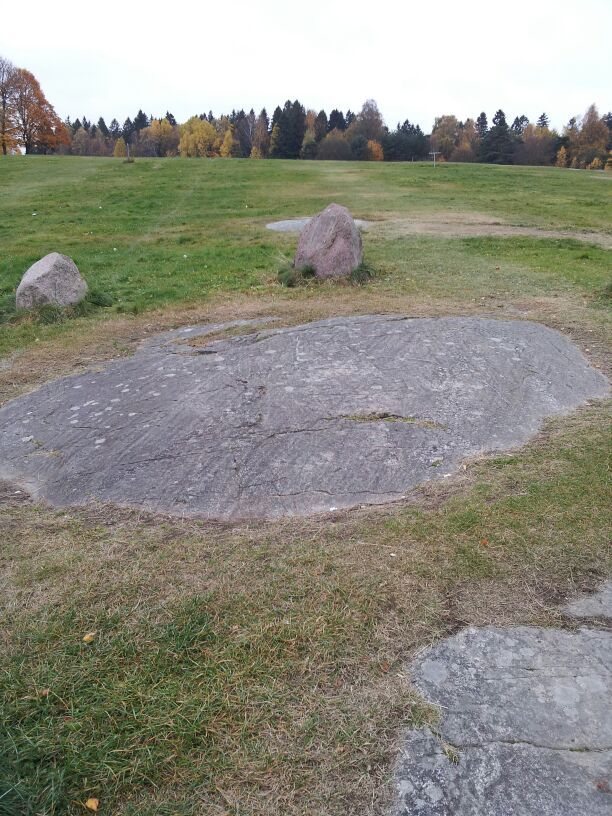
Close to a hundred cup marks, the largest panel on the walk. They cover the whole rock except the northern end. Several lie in rows, and several follow the cracks in the surface. They measure from two and a half to ten centimetres across and from one millimetre to three centimetres deep, so some are clear and others have almost gone. The panel lies by the burial cairns below the riding school.
Det ble funnet flere ved å fjerne mosen over S-delen, og det kan være enda flere der.
Kulturminnesøk, Riksantikvaren, NLOD 1.0

Trygve W Nodeland · CC BY-SA 4.0 · Wikimedia Commons Source: Kulturminnesøk, Riksantikvaren
-
11. Lille Ekeberg borettslag
Cup-mark panel
The last stop lies off the hill, a kilometre north-east of the riding school, inside a housing cooperative. Along the top of a knoll of bare rock lie twenty-one certain cup marks and a few uncertain ones, over an area four metres by one. Archaeologists recorded Ekeberg thoroughly in 1972 and have checked the panels several times since, but this one was not in any register until 2014. It was found by someone who lives here, and the register gives her name.
Skålgropene ble funnet i 2014 av lokalbeboer Kari Thelle.
Kulturminnesøk, Riksantikvaren, NLOD 1.0
Source: Kulturminnesøk, Riksantikvaren

More walks
- The medieval town in Gamlebyen (Oslo)
- Sagene and the falls of the Akerselva (Oslo)
- The synagogue that became a mosque (Oslo)
- Kvadraturen, the town that was moved (Oslo)
- Telthusbakken and Gamle Aker (Oslo)
- The brick town and the protected residential district (Oslo)
- Sámi and multicultural Oslo (Oslo)
- Traces of the war in the centre (Oslo)
- From Aros to Latinerkvarteret (Aarhus)
- Medieval Amsterdam (Amsterdam)
- Hendrick de Keyser's Amsterdam (Amsterdam)
- From the royal estate to Bryggen (Bergen)
- Viking and medieval Dublin (Dublin)
- The Georgian north city and the Rising of 1916 (Dublin)
- Constance Markievicz's Dublin (Dublin)
- The Royal Mile, castle to abbey (Edinburgh)
- Sophia Jex-Blake's Edinburgh (Edinburgh)
- From Senate Square to Katajanokka (Helsinki)
- Tove Jansson's Helsinki (Helsinki)
- Med Tang Kristensen til fortællerne (Jylland)
- The medieval town and the two fires (København)
- Christianshavn, the town by the canal (København)
- Hans Jonatan and the Schimmelmanns' Copenhagen (København)
- The City of London from Londinium to the Blitz (London)
- Olaudah Equiano's London (London)
- The medieval town on Stadsholmen (Stockholm)
- The heights of Söder after the fires (Stockholm)
- From Nidaros to Cicignon's town (Trondheim)
- The fortress and the working-class town (Trondheim)
Fornland, the free map of cultural heritage across northern and central Europe.