The synagogue that became a mosque
A walk in Oslo · 8 stops · 3.8 km, about 50 min on foot
Oslo has one synagogue in use and one that was closed in 1942, and on the way between them lie three mosques. The house at Calmeyers gate 15 b has been both. It was sold in 1981 and became Norway's first mosque, and today it is the Jewish Museum. The walk begins at the synagogue in Bergstien and ends two and a half kilometres further south-east, at the mosque in Åkebergveien.
-
1. Det Mosaiske Trossamfund
Synagogue, 1920
The congregation was founded in 1892 and moved several times before it came here. The synagogue was built in 1918 by the architect Herman Herzog and consecrated on 21 May 1920. Above the entrance is a quotation from the Tanakh in Hebrew, “This shall be a house of prayer for all peoples”. In 1940 about 1800 Jews lived in Norway. Around half of them got across to Sweden. About 770 were deported to German extermination camps, and 34 of them survived. In the 1946 census, 559 people in the country gave their faith as Mosaic.

Then: Jødenes synagoge - no-nb digifoto 20160202 00208 NB NS 000658Z, 1899 · Narve Skarpmoen · Public domain · Wikimedia Commons Source: Oslo Byleksikon
-
2. Calmeyers gate
Street of 1852
The street was named in 1852 after the merchant Mathias Calmeyer, who left a charitable bequest. At number 1, now number 5, stood Calmeyergatens Misjonshus from 1891, designed by Henrik Nissen, with a hall for around five thousand people. Christian Michelsen spoke here in 1905, and the hall was used for concerts until the 1950s. In the end the building was a warehouse, and it was demolished in the early 1970s. Further down the street are both a mosque and a synagogue that is no longer a synagogue.

Then: Indremissionen, Calmeyergt. - no-nb digifoto 20160122 00056 NB NS 000172A, 1899 · Narve Skarpmoen · Public domain · Wikimedia Commons Source: Oslo Byleksikon
-
3. Rabita-moskeen
Mosque
Det Islamske Forbundet was founded in 1978 and rented premises for more than twenty-five years, until it bought Calmeyers gate 8 in 2004 and fitted out three thousand square metres as a mosque. The congregation had 3318 members in 2018, with backgrounds in a number of countries. Moroccans are by far the largest group, and most are Arabs who have grown up in Norway. The Rabita scout group also holds its meetings here.
Source: Oslo Byleksikon
-
4. Jødisk Museum i Oslo
Synagogue, mosque, museum
The building inside the back yard was put up in 1919 and 1920 as the synagogue of Den Israelitiske Menighed, a breakaway group from Det Mosaiske Trossamfund, and consecrated in 1921. This was the east end's synagogue, and also a place where immigrants got help with the language, while the better-off went to Bergstien. The two congregations joined again in 1939, and in 1942 the building was closed. After the war the Jewish population was too small to keep it as a synagogue, and it became offices and storage. In 1981 it was sold and became Norway's first mosque. Later it was a gay club, and the museum opened in 2008. Out in the street, at number 15, 28 Jewish tenants were living in the autumn of 1942. Nineteen of them were arrested and killed at Auschwitz, and there are nineteen Stolpersteine in the pavement in front of the entrance.
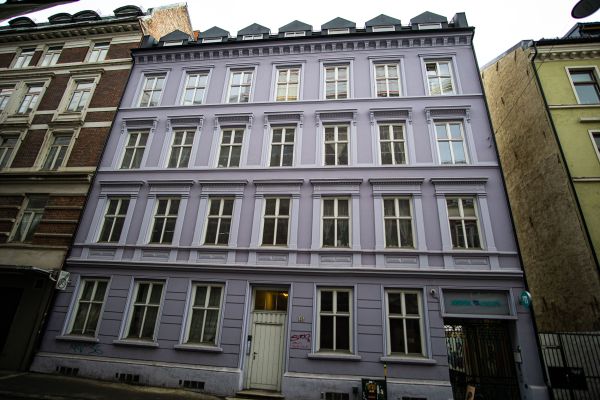
Aslak Malmåsen · Oslo Byleksikon Source: Oslo Byleksikon
-
5. Tøyenbekken (gate)
Police station and museum
The street was called Bekkegata before the town was extended in 1857 and took its name from the stream in 1952. At number 5 stood Grønland police station from 1902, with a two-storey cell wing facing the back yard. During the occupation a German Schnellkommando was based in the building. The police moved out in 1978, and since the conversion in 1998 Interkulturelt museum has had its premises here, as part of Oslo Museum.

Bjoertvedt · CC BY-SA 3.0 no · Wikimedia Commons Source: Oslo Byleksikon
-
6. Grønlandsleiret
Old road
The old road between Christiania and Oslo, meaning Gamlebyen, and older than the town extension of 1857. The road was boggy, and in the 1800s it was paved with the last remains of St Hallvard's Cathedral down in Gamlebyen. At number 26 the Communist Party of Norway was founded in November 1923, in a house that was demolished when Åkebergveien was extended here. The Buddhist Federation is at number 31. The city encyclopaedia lists Stolpersteine at several of the numbers, and the Moritz family at number 20 have four. The son Aksel lived at Calmeyers gate 15, and he, his wife and their two boys were deported on the “Donau”, the same ship as his mother.

Then: Fangen Carl Gustav Svendsen, 1857 · Adolph Tidemand · Public domain · Wikimedia Commons Source: Oslo Byleksikon
-
7. Islamic Cultural Centre
Mosque
ICC was founded in 1974 and is regarded as the first Islamic religious community in Norway, although there was unofficial activity before that. The site here was acquired in 1999, and the mosque opened on 20 February 2009. The building covers 3100 square metres and has room for 1300 people. The carpets and the mihrab, which shows the direction of Mecca, came from Turkey, the chandeliers from Poland. Most of those who belong here have a Pakistani background.

Ssu · CC BY-SA 4.0 · Wikimedia Commons Source: Oslo Byleksikon
-
8. World Islamic Mission
Mosque, 1995
The congregation began its work in Norway in 1984 and was housed in old warehouse premises in Urtegata and at Vahl upper secondary school before it got its own building. The foundation stone was laid on 12 April 1991, and the building was ready to move into in 1994/95. Egil Wæhle designed it in a traditional Islamic style, and the two minarets make it easy to pick out in the street. The façade is clad in ceramic tiles from Iran and Spain. This is the oldest building in Oslo built to be a mosque.
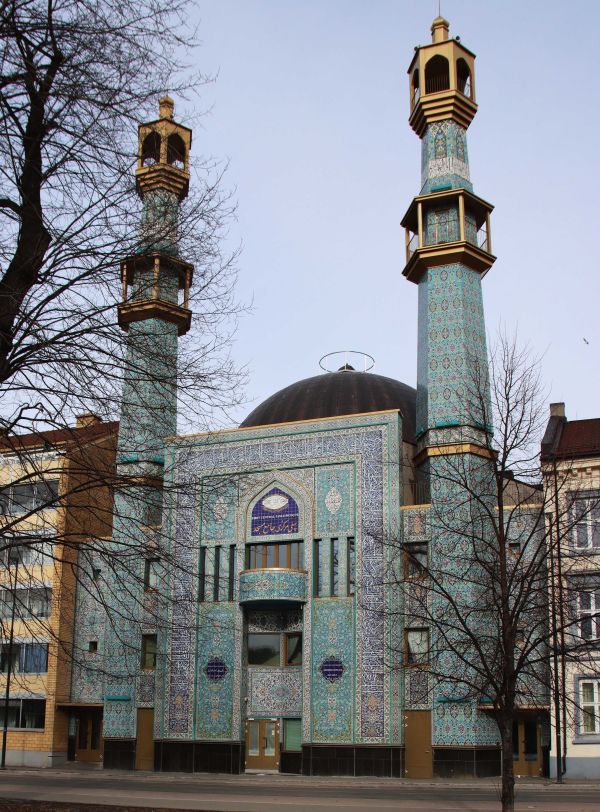
Oslo Byleksikon Source: Oslo Byleksikon


More walks
- The medieval town in Gamlebyen (Oslo)
- The cup marks on Ekeberg (Oslo)
- Sagene and the falls of the Akerselva (Oslo)
- Kvadraturen, the town that was moved (Oslo)
- Telthusbakken and Gamle Aker (Oslo)
- The brick town and the protected residential district (Oslo)
- Sámi and multicultural Oslo (Oslo)
- Traces of the war in the centre (Oslo)
- From Aros to Latinerkvarteret (Aarhus)
- Medieval Amsterdam (Amsterdam)
- Hendrick de Keyser's Amsterdam (Amsterdam)
- From the royal estate to Bryggen (Bergen)
- Viking and medieval Dublin (Dublin)
- The Georgian north city and the Rising of 1916 (Dublin)
- Constance Markievicz's Dublin (Dublin)
- The Royal Mile, castle to abbey (Edinburgh)
- Sophia Jex-Blake's Edinburgh (Edinburgh)
- From Senate Square to Katajanokka (Helsinki)
- Tove Jansson's Helsinki (Helsinki)
- Med Tang Kristensen til fortællerne (Jylland)
- The medieval town and the two fires (København)
- Christianshavn, the town by the canal (København)
- Hans Jonatan and the Schimmelmanns' Copenhagen (København)
- The City of London from Londinium to the Blitz (London)
- Olaudah Equiano's London (London)
- The medieval town on Stadsholmen (Stockholm)
- The heights of Söder after the fires (Stockholm)
- From Nidaros to Cicignon's town (Trondheim)
- The fortress and the working-class town (Trondheim)
Fornland, the free map of cultural heritage across northern and central Europe.